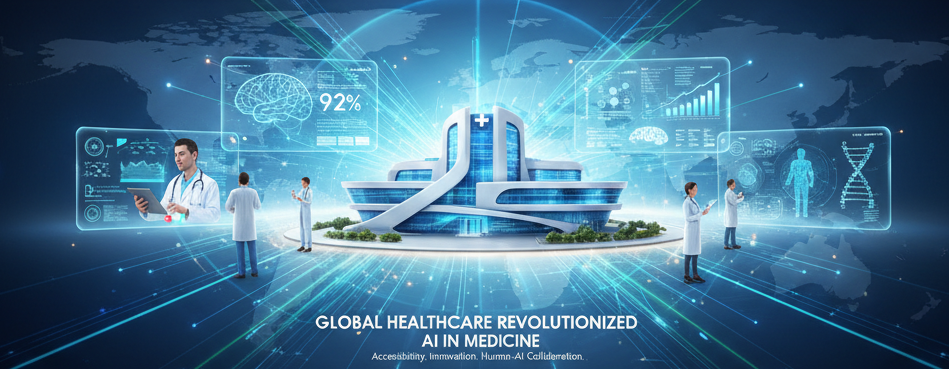
Artificial Intelligence (AI) is transforming healthcare delivery worldwide. AI is making care more accessible to more people, whether through diagnostics or patient monitoring, administrative functions or predictions, and so on. With the increasing healthcare demand (aging populations, chronic illnesses, and global health concerns) AI provides scalable solutions, which solve the quality and access challenges.
The Most Important Aspects Where AI is Making a Splash
AI is beginning to bring a difference in most areas of healthcare where conventional methods may be limited. Some of the key fields in which AI is transforming the care delivery process are listed below:
Traditional vs. AI-Powered Healthcare
| Feature | Traditional Methods | AI-Powered Methods |
|---|---|---|
| Data Analysis | Manual, time-consuming, prone to human error. | Automated, rapid, and capable of processing vast datasets for pattern recognition. |
| Diagnostics | Relies on human expertise and visual inspection; can be slower. | Augments human capability, providing faster, sometimes more accurate, analysis of medical images. |
| Treatment | Standardized or based on limited patient data. | Personalized and tailored to individual patient genetics, lifestyle, and medical history. |
| Administration | High manual workload for scheduling, billing, and record-keeping. | Automated processes that reduce errors and improve efficiency. |
| Access to Care | Limited by physical location and availability of specialists. | Expanded via remote monitoring and virtual consultations, reaching underserved areas. |
Predictive and Preventive Healthcare
European researchers have developed a new model, called Delphi-2M, that estimates susceptibility to more than 1,000 diseases more than 30 years in the future, using anonymized health data. This will enable health systems to act sooner and potentially play a major role in decreasing the burden of disease.
Patient medical histories, lab results, lifestyle and environmental factors are analyzed using AI tools to predict risks for conditions such as diabetes, cardiovascular disease, and sepsis. These predictive analytics allow health systems to plan resources, implement preventive care, and enhance long-term outcomes.
Diagnostic Accuracy and Medical Imaging
AI aids radiology: AI can scan MRIs, CT scans, or X-rays and highlight areas of concern faster and sometimes more accurately than humans. Tools such as those created by Aidoc are already used in hospitals to detect stroke, pulmonary embolism, or other severe conditions. This minimizes error and accelerates identification in acute cases, improving patient outcomes.
Telehealth and Home Care
Remote monitoring and virtual hospitals are extending healthcare to individuals who cannot easily access hospitals or clinics. For instance, the Seha Virtual Hospital in Saudi Arabia provides virtual consultations across multiple specialties. Similarly, AI monitoring of fetuses in Malawi clinics has significantly reduced stillbirth and infant mortality rates by providing real-time alerts of fetal distress.
Standardizing Administrative and Clinical Processes
Tasks like record keeping, clinician documentation, appointment scheduling, billing, and claims processing are time-consuming. AI can automate many of these, reducing errors and freeing clinicians to focus on patients. In hospitals, AI can forecast patient inflow, optimize bed allocation, and improve operating room scheduling, preventing bottlenecks and saving costs.
Individualized Therapy and Drug Discovery
With AI, treatment plans can be customized to each patient’s genetics, lifestyle, and medical history, leading to fewer side effects and better outcomes. AI also accelerates drug discovery by screening vast molecular combinations, predicting responses, and repurposing existing drugs — cutting research costs and time significantly.
The Adversities and Reflections
- Data quality and privacy: AI requires representative and unbiased datasets; poor quality data can cause unjust results.
- Regulation and validation: Many tools are promising but need clinical validation and regulatory approval before widespread use.
- Infrastructure and cost: Some areas lack broadband, sensors, and monitoring equipment needed to implement AI at scale.
Scaling AI: What Makes It Work
Successful large-scale AI requires interoperable health data systems, collaborations between tech and healthcare sectors, trained personnel who can use AI outputs, and regulations that ensure safety and fairness while fostering innovation.
Real-Life High-Scale Impact
From predictive models like Delphi-2M to AI-powered radiology tools and virtual hospitals, real-world implementations demonstrate how AI can be deployed at scale to improve access, speed, and outcomes.
Real-World AI Applications in Healthcare
| AI Tool/Application | Primary Function | Scalable Impact | Referred Link |
|---|---|---|---|
| Delphi-2M Model | Predictive risk assessment for over 1,000 diseases | Enables proactive public health policies and early screenings for populations. | Link |
| Aidoc | AI-powered medical imaging analysis | Accelerates diagnosis of acute conditions like stroke and pulmonary embolism, improving patient outcomes in critical care. | Link |
| Seha Virtual Hospital | Telehealth and remote specialist consultation | Extends healthcare access to rural and underserved regions, reducing geographical barriers to care. | Link |
| AI in Clinical Documentation | Automates note-taking and administrative tasks | Saves physicians hours per day, reducing burnout and allowing more focus on patient care. | Link |
Why Broad Adoption Matters
- Improved access to care, especially in underserved areas.
- Faster diagnosis and treatment, reducing complications and mortality.
- Less waste and inefficiency, lowering long-term healthcare costs.
- Individualized care, boosting patient satisfaction and outcomes.
AI is no longer experimental in healthcare — it is rapidly becoming central to how care is delivered on a large scale. From predictive models like Delphi-2M to virtual hospitals, AI-assisted records, and personalized treatment, the transformations are tangible and growing. With ethical, privacy, and regulatory challenges addressed, AI can make healthcare more accessible, efficient, and equitable worldwide.
When health systems invest in AI infrastructure, training, and validation, the benefits multiply. The critical factor is to use AI responsibly and with patient welfare at the forefront. The future of care delivery is now — and it is AI-powered.