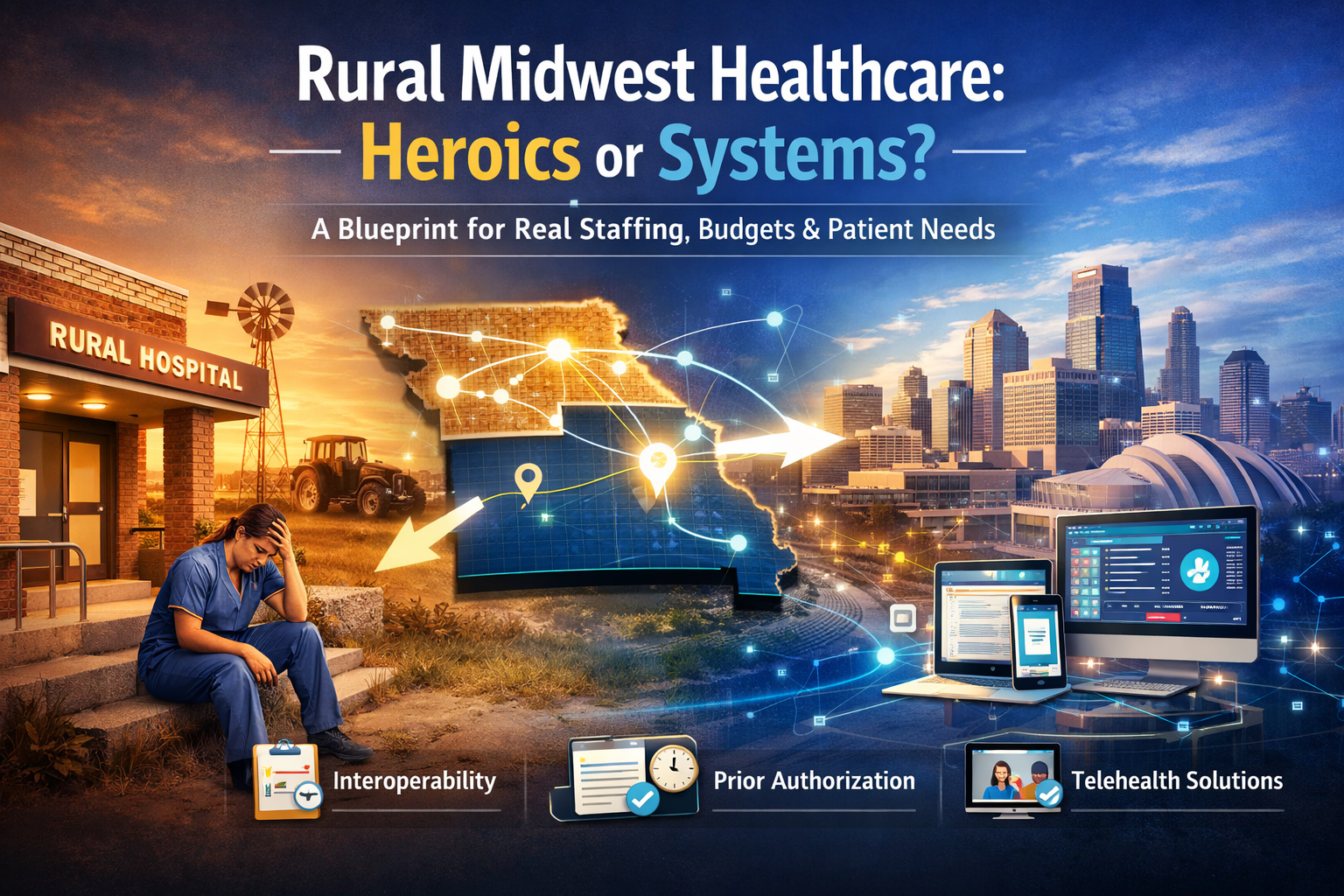
Key Takeaways
- •Rural hospitals and clinics aren't "behind." They're overloaded: thin margins, workforce gaps, and reporting + revenue-cycle complexity stack together. (Chartis)
- •Interoperability isn't a buzzword; it's the plumbing that prevents repeat work, missing context, and preventable denials—especially across MO/KS referral flows. (Missouri Department of Social Services)
- •Prior authorization is a measurable operational tax—often 13 hours/week per physician in survey data—so workflow automation is not "nice to have." (American Medical Association)
- •Telehealth can reduce hospitalizations in controlled evidence syntheses—tens to >100 fewer hospitalizations per 1,000 patients in cited findings—but only if broadband + workflows + data exchange exist. (PMC)
- •The fastest path is modular: start with one high-value pilot (RCM friction, referral leakage, quality reporting, or care coordination), then scale.
1) Hook: The Midwest Rural Scenario Everyone Recognizes
It's 4:45 pm. A patient needs a specialist appointment in Kansas City. The referral is "sent," but the receiving office wants documentation that lives in three places: EHR notes, a scanned PDF from a previous facility, and a payer portal screenshot somebody took because the portal timed out. Meanwhile, your HIM team is short-staffed, your nurse manager is triaging inbox messages, and your billing lead is staring at denials that look suspiciously like "missing information" you know you already had.
Nothing here is rare. It's the default mode when the system runs on human memory and heroics.
This post is about building the opposite: repeatable data and technology systems that reduce administrative load, improve care coordination across MO/KS networks, and create measurable financial and clinical lift—without requiring a Silicon Valley budget.
2) Why Rural Midwest is Uniquely Hard
- Financial pressure is structural. National rural-hospital analyses continue to flag high vulnerability and negative operating margins among a large share of rural facilities. One widely cited national rural health assessment reports 46% of rural hospitals with a negative operating margin and hundreds deemed vulnerable to closure. (Chartis)
- Workforce constraints are not a rounding error. In 2023, 92% of rural counties were designated primary care Health Professional Shortage Areas (HPSAs) in one national synthesis—meaning even "basic access" is staffing limited. (Commonwealth Fund)
- Digital access still gates what's possible. The FCC's 2024 Section 706 work emphasizes that fixed terrestrial broadband at modern benchmarks is not universally deployed—including in rural areas—which directly limits telehealth and data exchange reliability.
- Rural-urban care disparities are well documented in Medicare. CMS's rural-urban disparities reporting highlights differences in experiences and outcomes that intersect with access, geography, and system capacity. (Centers for Medicare & Medicaid Services)
3) Kansas City Metro Rural Reality: The Cross-State Catchment Problem
Kansas City is a regional gravity well for specialty care. Rural communities on both sides of the MO/KS line commonly rely on cross-system referrals, labs, imaging, and tertiary services—then patients return home, where follow-up happens in smaller hospitals, RHCs, FQHCs, home health, and public health programs.
KC Metro Rural Catchment
Think of the KC region as a hub with multiple spokes:
- Rural KS clinics/hospitals → Kansas City specialty + tertiary ecosystem ← Rural MO clinics/hospitals
- Public health reporting, immunizations, lab reporting
- Payer prior auth + claims workflows
What makes it solvable (and why it still breaks):
- Kansas has a statewide health information exchange presence (KHIN), founded to enable secure sharing among clinics, FQHCs, payers, hospitals, pharmacies, physicians, and public health. (khinonline.org)
- KHIN describes interoperability options including HL7 v2 interfaces, CCD exchange, public health reporting routes, and query-based exchange tapping national networks like eHealth Exchange and Care quality. (khinonline.org)
- Missouri's HIE landscape includes a state Health Information Network (HIN) and participation patterns that extend across multiple states—evidence that cross-border connectivity is already part of reality, not a future aspiration. (Missouri Department of Social Services)
4) The Real Blockers
1) Interoperability Gaps That Show Up as Workflow Pain
Not "can the EHR send a message," but: Can you find outside records quickly? Can you integrate them into your charting and decision-making? Can you do it across referral partners and across state lines? Evidence using national survey data suggests hospitals participating in HIOs report higher engagement in exchange domains than non-participants. (PMC)
2) Data Quality + Identity Problems
Rural settings often inherit fragmented identity data (name changes, old addresses, duplicate MRNs across systems). Without an MPI (master patient index) and data quality rules, analytics becomes a debate club.
3) Workforce Reality
When your analyst team is one person (or zero), dashboards don't stay updated, interfaces don't get monitored, and "automation" becomes another project you can't staff. Shortage area designations underline this constraint at population scale. (Commonwealth Fund)
From Manual Heroics to Scalable Healthcare Systems
5) Solutions as Modular "Build Blocks"
Below are 7 modules that rural Midwest organizations can mix-and-match. The important design choice: each module must produce a measurable operational outcome (time saved, denials reduced, referral completion improved, quality reporting stabilized).
Module A: Interoperability Foundation (HL7 v2 + CCD + FHIR Where It Counts)
What it is: Pragmatic integration layer with monitoring + message QA
Why it matters: Better referral handoffs, fewer "missing info" loops, less rework
Module B: Master Patient Index (MPI) + Data Quality Rules
What it is: Patient identity + matching system plus "quality gates"
Why it matters: If patient identity is messy, everything downstream becomes unreliable
Module C: Claims + EHR Linking for a Real Longitudinal View
What it is: Link payer claims with EHR events to see out-of-network utilization and denial drivers
Why it matters: Rural orgs can't optimize what they can't see—especially leakage to urban systems
Module D: Prior Authorization + Referral Automation
What it is: Automation (RPA) + templates + task routing with auditable trail
Why it matters: Prior auth consumes 13 hours/week per physician on average (AMA survey)
Module E: Population Health Analytics + Quality Measures (Built for Small Teams)
What it is: Slim, governed metrics layer with risk stratification and care gaps
Why it matters: Value-based models demand measurement, but rural teams need "few metrics, done well"
6) Fact Table: Rural Operational Pain Points → Data/Tech Interventions
| Rural Operational Pain Point | What It Looks Like on the Ground | Data/Tech Intervention | Measurable Outcome to Track |
|---|---|---|---|
| Referral leakage + poor follow-through | "We sent it" but patient never gets scheduled | Referral workflow + data exchange + status tracking | Referral completion rate; time-to-appointment |
| Prior auth delays | Staff phone calls + portal hopping | RPA + templates + documentation extraction | Avg PA turnaround; denial rate; staff hours |
| Fragmented records across MO/KS | Duplicate imaging/labs; missing meds list | HL7/CCD/FHIR exchange + HIE connectivity | Outside record retrieval time; duplicate tests |
| Denials + documentation mismatch | "Missing info" denials | Claims–EHR linking + denial analytics | Denial rate; days in A/R |
| Under-resourced analytics | Dashboards go stale | Lakehouse/warehouse + managed BI ops | Refresh reliability; decision-cycle time |
7) Pilot-to-Scale: A Rural-Friendly 30/60/90-Day Plan
Days 0–30: Pick One Workflow and Make It Measurable
- Define one "line of pain" (prior auth, referrals, denials, quality reporting, public health reporting)
- Baseline metrics (time-to-auth, denial rate, referral completion, manual touches)
- Confirm data-sharing pathways (KHIN/HIN participation where applicable)
Days 31–60: Build the Minimum Viable Data + Automation Layer
- Stand up interface monitoring + logging
- Implement one automation (e.g., PA packet assembly + status tracking)
- Create one dashboard that people use weekly (not "someday")
Days 61–90: Harden + Scale
- Add governance: data dictionary, access controls, auditability
- Expand to second payer/service line or second referral network
- Document ROI in operational terms (hours saved, denials avoided, faster scheduling)
8) How Smart Tech LLC Can Partner and Help
Smart Tech LLC is positioned as a technology partner for rural Midwest organizations that need interoperability, analytics, automation, and AI enablement to work under real constraints—limited staff, limited time, and high reporting + RCM complexity.
A practical engagement model that fits rural reality:
- Discovery + roadmap (2–4 weeks): identify 1–2 workflows where data/tech can measurably reduce burden
- Pilot (30–90 days): deliver one working integration + one operational dashboard + one automation
- Scale: expand across service lines, partners, and reporting requirements
9) Replace Heroics with an Operating System
Rural Midwest healthcare will always require grit. The goal isn't to "digitize everything." The goal is to stop spending scarce clinical and operational energy on problems that software and data discipline can reliably handle.
The evidence is blunt:
- Rural financial vulnerability persists (Chartis)
- Workforce shortage areas are widespread (Commonwealth Fund)
- Administrative friction like prior auth is quantifiably damaging (American Medical Association)
- Telehealth can reduce utilization, but only when the underlying system supports it (PMC)
Next Steps:
- Choose a workflow: prior auth, denials, referrals, quality reporting or use case of your choice
- Bring 1-3 months of baseline metrics (even estimates)
- Schedule a 30-minute scoping call
Frequently Asked Questions
1) Do we need FHIR to start?
Not always. Many high-value wins start with HL7 v2 + CCD + Direct messaging, then add FHIR where structured integration improves reliability.
2) We're already connected to an HIE—why is it still hard?
Connectivity isn't usability. The hardest part is workflow integration (finding and integrating outside info) and governance.
3) Is prior auth automation worth it?
Given reported time burden and downstream care impact in national physician survey data, prior auth is one of the most ROI-visible targets for automation.
4) How do we handle MO/KS cross-border data exchange?
Start with what exists: Kansas HIE services and Missouri HIN participation patterns indicate cross-network exchange is already part of operations.
Sources
- Chartis: National Rural Health Assessment (2024-2025)
- Missouri Department of Social Services: Health Information Network Documentation
- American Medical Association: Prior Authorization Physician Survey (2024)
- PMC: Systematic Review of Telehealth Impact (2025)
- Commonwealth Fund: Rural Health Professional Shortage Areas Analysis (2023)
- UNC Sheps Center: Rural Hospital Closures/Conversions (Updated Dec 4, 2025)
- KHIN: Kansas Health Information Network Services Documentation
- PMC: National Survey on Health Information Exchange Participation